A Data-Driven Strategy to Restore Starbucks' Essence
From efficiency-driven operations to emotionally-centered experiences
"In gaining speed, what did we lose?"
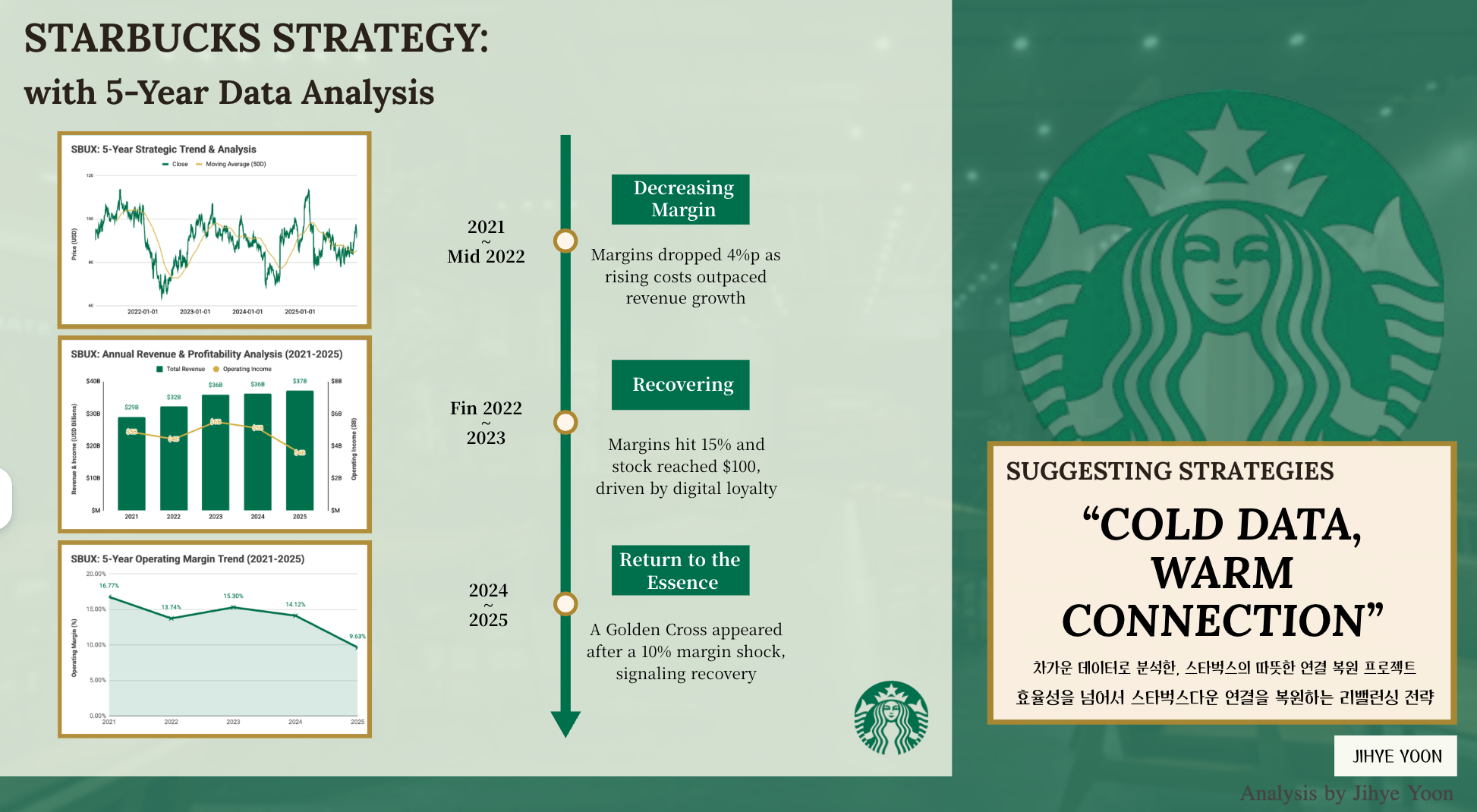
"More stores, faster orders." The efficiency and speed that Starbucks has pursued have become a double-edged sword. Despite record-breaking revenue, declining operating profit margins and stock price volatility force us to ask critical questions.
This analysis diagnoses Starbucks' crisis through Cold Data (quantitative analysis) using Python and Excel, and proposes strategies to restore the brand's essence: Warm Connection (emotional engagement).
Independent visualization analysis: Market indicators extracted via Python (yfinance) and reprocessed through Google Sheets
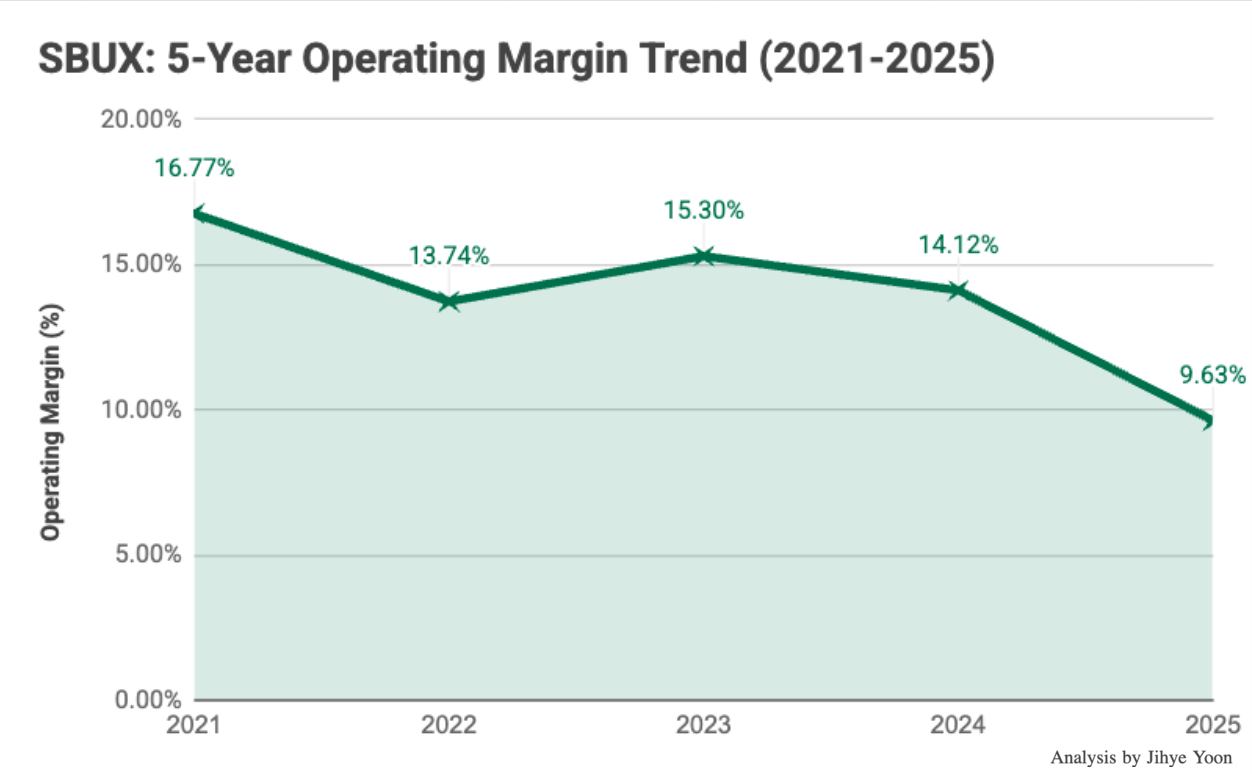
Visualized 5-year operating margin trend to measure core business efficiency.
Operating Margin (%) = (Operating Income / Total Revenue) × 100
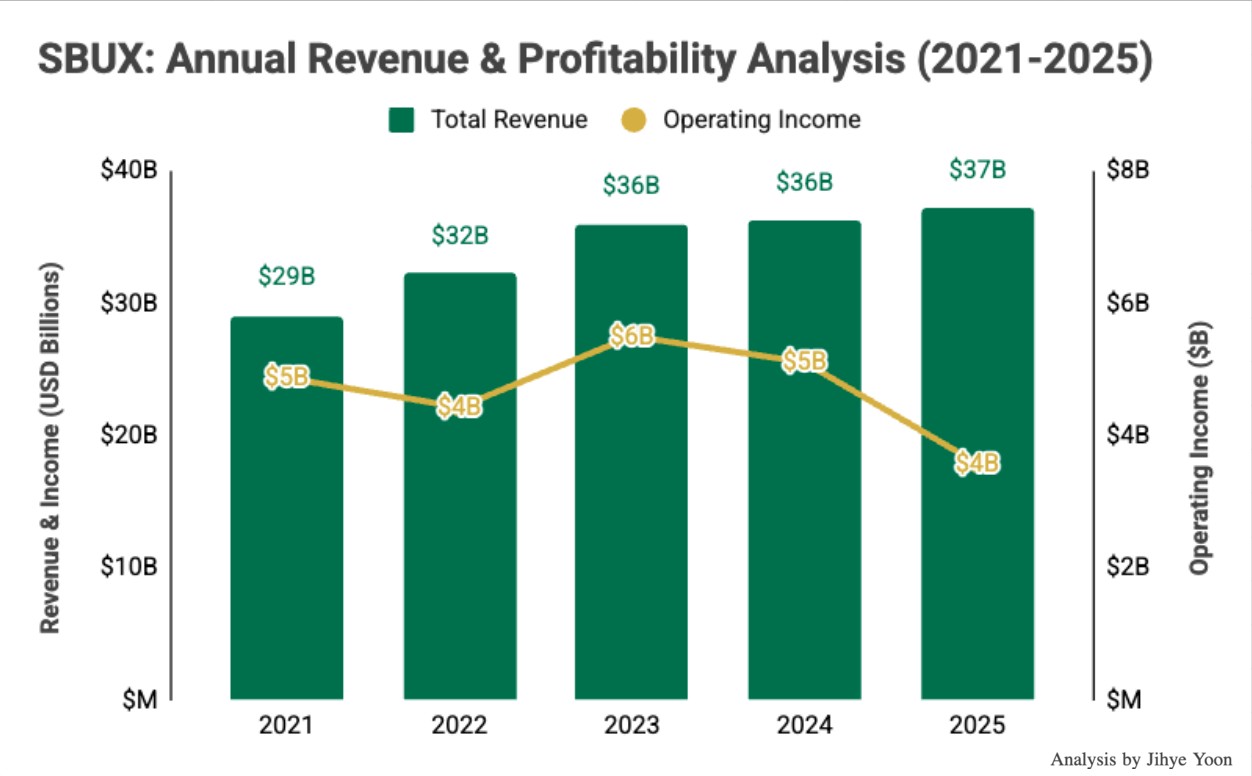
Direct comparison of annual Total Revenue and Operating Income trends to capture the "profitability shock" period and identify structural limitations in growth translation.
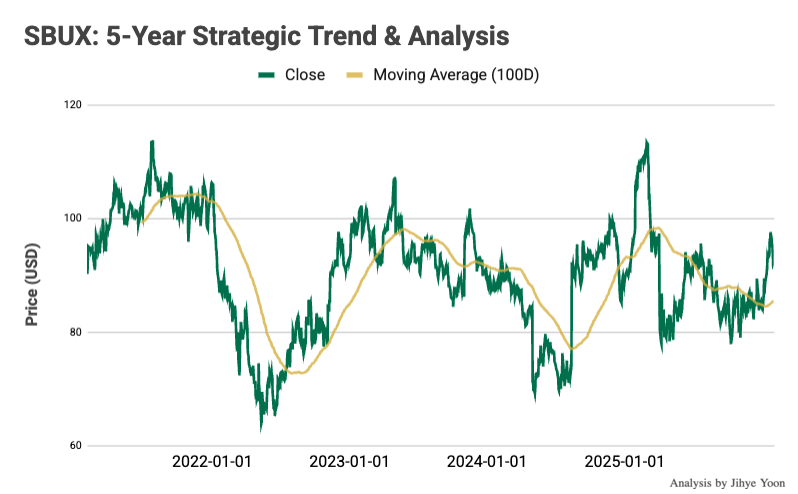
Combined daily closing price data from Python with 100-day Moving Average to visualize long-term value trajectory and identify strategic trend patterns.
Cross-analysis of data and news/interviews reveals three decisive contradictions
Order time reduced from 6 to 4 minutes has transformed partners into "manufacturing machines" and customers into "order numbers," eroding the human connection that defines the Starbucks experience.
Over-reliance on morning "Caffeine Rush" creates afternoon Dead Time, intensifying store vacancy rates and rent burdens while leaving valuable capacity underutilized.
Supply chain issues and labor disputes weaken the justification for the "premium" that consumers pay, undermining the brand's value proposition and customer loyalty.
Monetizing afternoon dwell time to defend profitability and restore brand value
Compensating Morning Rush with Afternoon Value
Core Concept: Combine Beacon technology with gamification to transform store dwell time into "warm experiences" captured as data.
Beacon technology visualizes customer dwell time as "Digital Tree Growing." The tree's background displays the store's actual suppliers, partner education history, and videos, giving customers "joy of staying" while Starbucks gains "transparent trust."
Drive-thru and mobile users receive digital tree growth accelerators based on consecutive visit data. Routine users during afternoon hours (2–5 PM) receive limited menu reservations and exclusive merchandise priority, distributing traffic to afternoons.
Afternoon purchases convert discounts into "community donations." Customers gain psychological satisfaction from "making a positive impact in our neighborhood," realizing the Neighborhood Value central to American culture.
Restore collapsed brand trust and space value / Defend operating margin
Beacon-based gamification / Supply chain & partner visualization / Omnichannel routine design
Customers seeking afternoon focus & rest / Efficiency-driven DT & mobile users / Morning customers
Starbucks app and North American offline stores
Afternoon hours: 2 PM to 5 PM (The Second Peak)
Reallocate marketing budget from "discounts" to "local donations" and "experience design" to protect profitability
"Reviving the value of abandoned time through data,
and restoring lost emotional bonds through technology."
The data signals a "restart" for Starbucks to return to its original spirit. While revenue has grown but substance has diminished, Starbucks is pursuing "futuristic evolution" that maintains its 1971 Seattle roots while embracing AI and modern lifestyle trends.
This project aims beyond simply increasing revenue figures. Its purpose is to implement what Starbucks stands for—"genuine connection with customers" and "restoration of trust"—through technology.
By diagnosing with Cold Data and completing with Warm Connection, this strategy will become the core driving force for Starbucks to re-emerge as the most forward-thinking brand without losing its essence.